
Breaking News
Showing posts with label drilling. Show all posts
Showing posts with label drilling. Show all posts
Sunday, 21 September 2014

Petroleum Drilling - Alaska Department of Labor and ...
Petroleum Drilling - Alaska Department of Labor and ...


Wednesday, 17 September 2014

Monday, 15 September 2014
Drilling Rig Equipment
Rig equipment

- Blowout Preventer:- The equipment associated with a rig is to some extent dependent on the type of rig but (#23 & #24) are devices installed at the wellhead to prevent fluids and gases from unintentionally escaping from the borehole. #23 is the annular (often referred to as the “Hydril”, which is one manufacturer) and #24 is the piperam and blind rams. In the place of #24 Variable bore hole or VBRs can be used. These offer the same pressure and sealing capacity found in standard pipe rams, while offering the versatility of sealing on various sizes of drill pipe, production tubing and casing without changing standard pipe rams. Normally VBRs are used when utilizing a tapered drill string (when different size drill pipe is used in the complete drill string).
- Cintrifuge:- an industrial version of the device that separates fine silt and sand from the drilling fluid.
- Solid control: solids control equipments for preparing drilling mud for the drilling rig.
- Chane Tong: wrench with a section of chain, that wraps around whatever is being tightened or loosened. Similar to a pipe wrench.
- Degasser: a device that separates air and/or gas from the Drilling fluid.
- Desender / desilter: contains a set of hydrocyclones that separate sand and silt from the drilling fluid.
- Draw works: (#7) is the mechanical section that contains the spool, whose main function is to reel in/out the drill line to raise/lower the traveling block (#11).
- Drill Bit: (#26) is a device attached to the end of the drill string that breaks apart the rock being drilled. It contains jets through which the drilling fluid exits.
- Drill Pipe: (#16) joints of hollow tubing used to connect the surface equipment to the Bottom Hole Assembly (BHA) and acts as a conduit for the drilling fluid. In the diagram, these are “stands” of drill pipe which are 2 or 3 joints of drill pipe connected together and “stood” in the derrick vertically, usually to save time while tripping pipe.
- Elevators: a gripping device that is used to latch to the drill pipe or casing to facilitate the lowering or lifting (of pipe or casing) into or out of the borehole.
- Mud motors: a hydraulically powered device positioned just above the drill bit used to spin the bit independently from the rest of the drill string.
- Mud pumps: (#4) reciprocal type of pump used to circulate drilling fluid through the system.
- Mud tanks: (#1) often called mud pits, provides a reserve store of drilling fluid until it is required down the wellbore.
- Rotary tables: (#20) rotates the drill string along with the attached tools and bit.
- Shale Shaker: (#2) separates drill cuttings from the drilling fluid before it is pumped back down the bore hole.
Well Control System
Well control system

Mud pumps
standpipe manifold
stand pipe
kelly hose
gooseneck
swivel kelly upper and lower kelly sub
kelly saber sub
drill string
bit
annulus
bill nipple
flow line
shale shaker
degasser
desander
desilter or mud cleaner
centrifuge
choke manifold
poor boy degesser
trip tanker
slug tank
active pit
reserve tanks
suction tank
super changer pumps
Hoistng System
Hoisting system

Drilling
Drilling for oil and gas
Reaching into the reservoir
When all the experts have been consulted, the risks have been assessed, the environmental studies have been carried out and the data has been compiled into workable maps of the exploration site, it’s time to send in the drilling crew.Before any drilling begins on land we may have to build access roads, construct a temporary power station or install wells for the water supply. In fragile habitats or very remote places helicopters or barges may be the only responsible way to get equipment and supplies into place.
Drilling for oil in the winds, currents and choppy waters of the open seas is even more challenging. The most difficult part is getting a drilling rig to stay in position despite the currents and waves.
 BP's Dada Gorgud rig
Three types of rigs
In shallower water of up to 100 metres, we use what is called a jack-up unit. It starts out as a barge, which is towed into place. Legs extend to the sea floor and then the barge lifts out of the water, becoming a stable drilling platform.In rougher seas or water up to 300 metres deep we use some of the water itself as a counterweight. A semi-submersible drilling rig is a platform attached to submerged pontoons. When the pontoons are flooded with water they lower into the ocean, meaning waves don’t affect the platform nearly as much.
In the most extreme deepwater situations we bring in the most heavyweight drilling option available, the drill ship. Drill ships are held in place by large anchors or by dynamic positioning systems, which use computer-controlled propellers to help the ship stay in place.
Studying the mud
Even at this stage, with crews and heavy machinery in place, there is a possibility that nothing will be found. Or the oil and gas discovered could be of such small quantities that extracting it would not be worthwhile.As the diamond or tungsten drill bit goes into the hard rock, a substance called ‘mud’ is pumped down through the pipe. This mud isn’t really mud. It’s a fluid consisting of water, clay, additives and thickeners. It both cools the drill bit, which can get really hot, and flushes out the shards of cut rock from the reservoir.
As the mud comes back up through the outer part of the pipe, we get the first hard evidence showing whether we were right about the resources at the site. Geologists monitor the cuttings to check whether they’re coming out in the sequences they expected, while records of the mud and rock fragments are kept for further study later on.
Once the exploratory well has been drilled, various instruments are lowered into it so we can learn more about the reservoir. This way we measure the natural radioactivity and electrical resistance of the rocks, as well as the pressure and temperature of the fluids or gases.
Safety first
Because crude oil and natural gas are hot and highly pressurized, we have to take great care to control pressure during the drilling process.Everyone involved in a drilling project undergoes rigorous safety training. Risks are assessed at every step. Increasingly we plan exploration projects remotely, using data instead of site visits, which means fewer employees and contractors are exposed to potential dangers on the actual rig.
Cementing
Cementing
 After
the casing string is run, the next task is cementing the casing in
place. An oil-well cementing service company is usually called in for
this job although, as when casing is run, the rig crew is available to
lend assistance.
After
the casing string is run, the next task is cementing the casing in
place. An oil-well cementing service company is usually called in for
this job although, as when casing is run, the rig crew is available to
lend assistance.
Cementing service companies stock various types of cement and have special transport equipment to handle this material in bulk. Bulk-cement storage and handling equipment is moved out to the rig, making it possible to mix large quantities of cement at the site. The cementing crew mixes the dry cement with water, using a device called a jet-mixing hopper. The dry cement is gradually added to the hopper, and a jet of water thoroughly mixes with the cement to make a slurry (very thin water cement).
 Special
pumps pick up the cement slurry and send it up to a valve called a
cementing head (also called a plug container) mounted on the topmost
joint of casing that is hanging in the mast or derrick a little above
the rig floor. Just before the cement slurry arrives, a rubber plug
(called the bottom plug) is released from the cementing head and
precedes the slurry down the inside of the casing. The bottom plug stops
or "seats" in the float collar, but continued pressure from the cement
pumps open a passageway through the bottom plug. Thus, the cement slurry
passes through the bottom plug and continues on down the casing. The
slurry then flows out through the opening in the guide shoe and starts
up the annular space between the outside of the casing and wall of the
hole. Pumping continues and the cement slurry fills the annular space.
Special
pumps pick up the cement slurry and send it up to a valve called a
cementing head (also called a plug container) mounted on the topmost
joint of casing that is hanging in the mast or derrick a little above
the rig floor. Just before the cement slurry arrives, a rubber plug
(called the bottom plug) is released from the cementing head and
precedes the slurry down the inside of the casing. The bottom plug stops
or "seats" in the float collar, but continued pressure from the cement
pumps open a passageway through the bottom plug. Thus, the cement slurry
passes through the bottom plug and continues on down the casing. The
slurry then flows out through the opening in the guide shoe and starts
up the annular space between the outside of the casing and wall of the
hole. Pumping continues and the cement slurry fills the annular space.
A top plug, which is similar to the bottom plug except that it is solid, is released as the last of the cement slurry enters the casing. The top plug follows the remaining slurry down the casing as a displacement fluid (usually salt water or drilling mud) is pumped in behind the top plug. Meanwhile, most of the cement slurry flows out of the casing and into the annular space. By the time the top plug seats on or "bumps" the bottom plug in the float collar, which signals the cementing pump operator to shut down the pumps, the cement is only in the casing below the float collar and in the annular space. Most of the casing is full of displacement fluid.
After the cement is run, a waiting time is allotted to allow the slurry to harden. This period of time is referred to as waiting on cement or simply WOC.
After the cement hardens, tests may be run to ensure a good cement job, for cement is very important. Cement supports the casing, so the cement should completely surround the casing; this is where centralizers on the casing help. If the casing is centered in the hole, a cement sheath should completely envelop the casing. Also, cement seals off formations to prevent fluids from one formation migrating up or down the hole and polluting the fluids in another formation. For example, cement can protect a freshwater formation (that perhaps a nearby town is using as its drinking water supply) from saltwater contamination. Further, cement protects the casing from the corrosive effects that formation fluids (as salt water) may have on it.
Read more ...
After
the casing string is run, the next task is cementing the casing in
place. An oil-well cementing service company is usually called in for
this job although, as when casing is run, the rig crew is available to
lend assistance.
Cementing service companies stock various types of cement and have special transport equipment to handle this material in bulk. Bulk-cement storage and handling equipment is moved out to the rig, making it possible to mix large quantities of cement at the site. The cementing crew mixes the dry cement with water, using a device called a jet-mixing hopper. The dry cement is gradually added to the hopper, and a jet of water thoroughly mixes with the cement to make a slurry (very thin water cement).
Special
pumps pick up the cement slurry and send it up to a valve called a
cementing head (also called a plug container) mounted on the topmost
joint of casing that is hanging in the mast or derrick a little above
the rig floor. Just before the cement slurry arrives, a rubber plug
(called the bottom plug) is released from the cementing head and
precedes the slurry down the inside of the casing. The bottom plug stops
or "seats" in the float collar, but continued pressure from the cement
pumps open a passageway through the bottom plug. Thus, the cement slurry
passes through the bottom plug and continues on down the casing. The
slurry then flows out through the opening in the guide shoe and starts
up the annular space between the outside of the casing and wall of the
hole. Pumping continues and the cement slurry fills the annular space.A top plug, which is similar to the bottom plug except that it is solid, is released as the last of the cement slurry enters the casing. The top plug follows the remaining slurry down the casing as a displacement fluid (usually salt water or drilling mud) is pumped in behind the top plug. Meanwhile, most of the cement slurry flows out of the casing and into the annular space. By the time the top plug seats on or "bumps" the bottom plug in the float collar, which signals the cementing pump operator to shut down the pumps, the cement is only in the casing below the float collar and in the annular space. Most of the casing is full of displacement fluid.
After the cement is run, a waiting time is allotted to allow the slurry to harden. This period of time is referred to as waiting on cement or simply WOC.
After the cement hardens, tests may be run to ensure a good cement job, for cement is very important. Cement supports the casing, so the cement should completely surround the casing; this is where centralizers on the casing help. If the casing is centered in the hole, a cement sheath should completely envelop the casing. Also, cement seals off formations to prevent fluids from one formation migrating up or down the hole and polluting the fluids in another formation. For example, cement can protect a freshwater formation (that perhaps a nearby town is using as its drinking water supply) from saltwater contamination. Further, cement protects the casing from the corrosive effects that formation fluids (as salt water) may have on it.
Drilling Fluids
Drilling Fluid (Mud) & Functions
Drilling mud which is one of the essential need in drilling
operations. Drilling Mud is a semi liquid fluid just like a pap which
consists of liquid, water or oil, with solids in suspension. It is used
to cool and clean off the bits
as it rotates to the bottom of the earth. On the drilling rig, mud is
pumped down through the drillstring where it spray out through the
nozzles on the drill bit, cleaning and cooling off the bit in the
process. Its then carry drill cutting up through the annulus where it is
being filter out using a shale shaker. After filtration of the mud, it is then return to the mud pit
where they are being treated by addition of chemicals and other
substance. The mud can be reused by pumping it downhole and further
re-circulated. Drilling mud can also be called drilling fluid. Drilling
fluid also makes drilling operation easy for the drillers.
Drilling mud are categories into three section.- Water based mud(WBM)
- Oil based mud
- Gas based mud (GBM)
WATER BASED MUD (WBM)
WBM comprises of water, clay and other chemicals. Its looks like chocolate milk and malt in resembrance when it is an homogenous mixture. A good example of this is bentonite. Water based mud are classified as:
-
Non-Inhibitive such as clay water, Native, Bentonite/water, Lignite/Ligno-Sulfonate (Deflocculated).
-
Inhibitive can be calcium based, salt water based or potassium based.
-
Polymer such as Non-Dispersed, High temperature deflocculated.
Non-Inhibitive Fluid or Mud
Non-inhibitive fluids are generally used as spud muds. Those which do not significantly suppress clay swelling, are generally comprised of native clays or commercial bentonites with some caustic soda or lime. They may also contain deflocculants and/or dispersants such as: lignites, lignosulfonates, or phosphates. Native solids are allowed to disperse into the system until rheological properties can no longer be controlled by water dilution.
Inhibitive Fluid or Mud
Those which appreciably retard clay swelling and, achieve inhibition through the presence of cations; typically, Sodium (Na+), Calcium (Ca++) and Potassium (K+). Generally, K+ or Ca++, or a combination of the two, provide the greatest inhibition to clay dispersion. These systems are generally used for drilling hydratable clays and sands containing hydratable clays. Because the source of the cation is generally a salt, disposal can become a major portion of the cost of using an inhibitive fluid.
Polymer Fluid or Mud
These fluids can be inhibitive or non-inhibitive depending upon whether an inhibitive cation is used. Polymers can be used to viscosify fluids, control filtration properties, deflocculate solids, or encapsulate solids. The thermal stability of polymer systems can range upwards to 400°f. In spite of their diversity, polymer fluids have limitations. Solids are a major threat to successfully running a cost-effective polymer mud system.
OIL BASED MUD (OBM)
OBM is a petroleum product which is used as a drilling fluid. example of OBM is diesel fuel, mineral and Non-Petroleum Hydrocarbon. OBM is used in the drilling operation for several reason such as increasing the lubricity of a tool, increasing cleaning abilities with less viscosity and enhanced shale inhibition.
A primary use of oil-based fluids is to drill troublesome shales and to improve hole stability. They are also applicable in drilling highly deviated holes because of their high degree of lubricity and ability to prevent hydration of clays. They may also be selected for special applications such as high temperature/high pressure wells, minimizing formation damage, and native-state coring. Another reason for choosing oil-based fluids is that they are resistant to contaminants such as anhydrite, salt, and CO2 and H2S acid gases.
Cost is a major concern when selecting oil-based muds. Initially, the cost per barrel of an oil-based mud is very high compared to a water-based mud system. However, because oil muds can be reconditioned and reused, the costs on a multi-well program may be comparable to using water-based fluids.
Today, with increasing environmental concerns, the use of oil-based muds is either prohibited or severely restricted in many areas. In some areas, drilling with oil-based fluids requires mud and cuttings to be contained and hauled to an approved disposal site. The costs of containment, hauling, and disposal can greatly increase the cost of using oil-based fluids.
SYNTHETIC BASED FLUID (SBM)
SBM which is also known as Pneumatic fluid is mostly used on offshore rigs because of its properties which consists of Oil based mud but the toxicity of the fluid fumes are much less than the oil based mud. SBM are sometimes called low toxicity oil based mud (TOBM). SBM consists of synthetic oil. Examples are dry gases, mist, foam and gasified mud.
Pneumatic (air/gas based) fluids are used for drilling depleted zones or areas where abnormally low formation pressures may be encountered. An advantage of SBM fluids over liquid mud systems is use in increasing penetration rates. Cuttings are literally blown off the cutting surface ahead of the bit as a result of the considerable pressure differential. The high pressure differential also allows formation fluids from permeable zones to flow into the wellbore. Air/gas based fluids are ineffective in areas where large volumes of formation fluids are encountered. A large influx of formation fluids requires converting the pneumatic fluid to a liquid-based system. As a result, the chances of losing circulation or damaging a productive zone. Another consideration when selecting pneumatic fluids is well depth. They are not recommended for wells below about 10,000 ft because the volume of air required to lift cuttings from the bottom of the hole can become greater than the surface equipment can deliver.
Function of Drilling mud.
Generally, Drilling mud serves as a muti purpose function in the oil and gas industries. Download to device or Review. Below is the overall functions of a drilling mud.
-
Non-Inhibitive such as clay water, Native, Bentonite/water, Lignite/Ligno-Sulfonate (Deflocculated).
-
Drilling mud serve as a cooling agent to cool and lubricate the bit and drill string.
-
It is also used to clean the bit while rotating.
-
Its help to transporting cuttings and carvings from the well to the surface.
-
Its transmit energy to tools and bit which help drilling easier for the drillers.
-
Drilling fluid is used to control sub-surface and formation pressure.
-
Assist in the gathering of subsurface geological data and formation evaluation.
-
It helps to support and maintain stabilization of wellbore and control corrosion on drillstring and casing.
-
Its makes cementing and completion operation easier.
-
Minimize lost circulation.
-
Drilling mud provide medium for wireline logging.
-
Improve penetration rates.
-
Its ensure formation evaluation and seal formation pressure.
-
It reduces friction of the drill string.
-
Reduce pressure Losses.
-
Support weight of tubulars.
-
Drilling fluid reduce stuck pipe.
-
Reduce environmental impact.
-
Improve Safety.

PROPERTIES OF A DRILLING MUD ARE:
-
Density or Weight (lbs/gal)
-
Viscosity: it’s resistance to flow
-
Yield Point
-
Solids content
Do not think that a drilling mud or fluid is the same as a completion fluid. Is totally a different fluid. A completion fluid is a fluid used when a well is being completed, that why it's called a completion fluid. It is selected not only for its ability to control formation pressure but also for the properties that minimize formation damage.
Mud Circulation System
Mud Circulation System
Drilling mud is a important part for the drilling work to maintain the wellbore; Cool, lubricate and support the bit and drilling assembly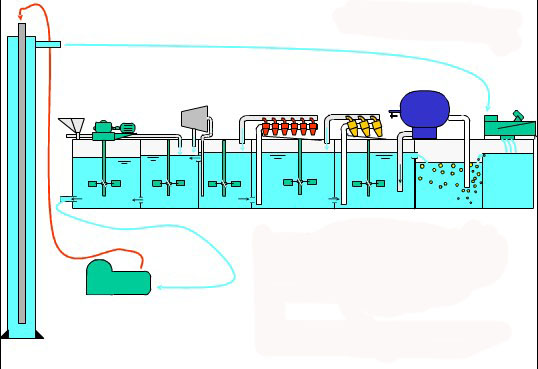 and so on, most important, remove cuttings from well. Then here it problem, to reuse the drilling mud. Then it is the time for mud circulating system to come here.
In some applications, the mud circulating system is equal to solids control system, but the full mud circulating system in drilling work, contains more. Except for the four phase, five equipments as we know, shale shaker, vacuum degasser, desander and desilter (or mud cleaner), decanter centrifuge. There also include mud pump, electric generator, control panel, chemical reagent treatment unit, and so on.
As you can see in the picture. It is used for the movable drilling rig, and also this system is movable. Usuall solids control equipments can not prevent the loss of the drilling mud. So we also must add chemic to the tanks to add fresh drilling fluids.
 Other parts are also very important, centrifugal pump, mud agitator, mud gun.
The main part in the picture:
1. Shale shaker
8. Desander
9. Desilter
10. Centrifuge
12. Mud pump
20. Sludge pump
23. Mud agitator
27. Submersible pump.
Sunday, 14 September 2014

Subscribe to:
Posts (Atom)